What Happens to a Camel’s Blood During Dehydration?
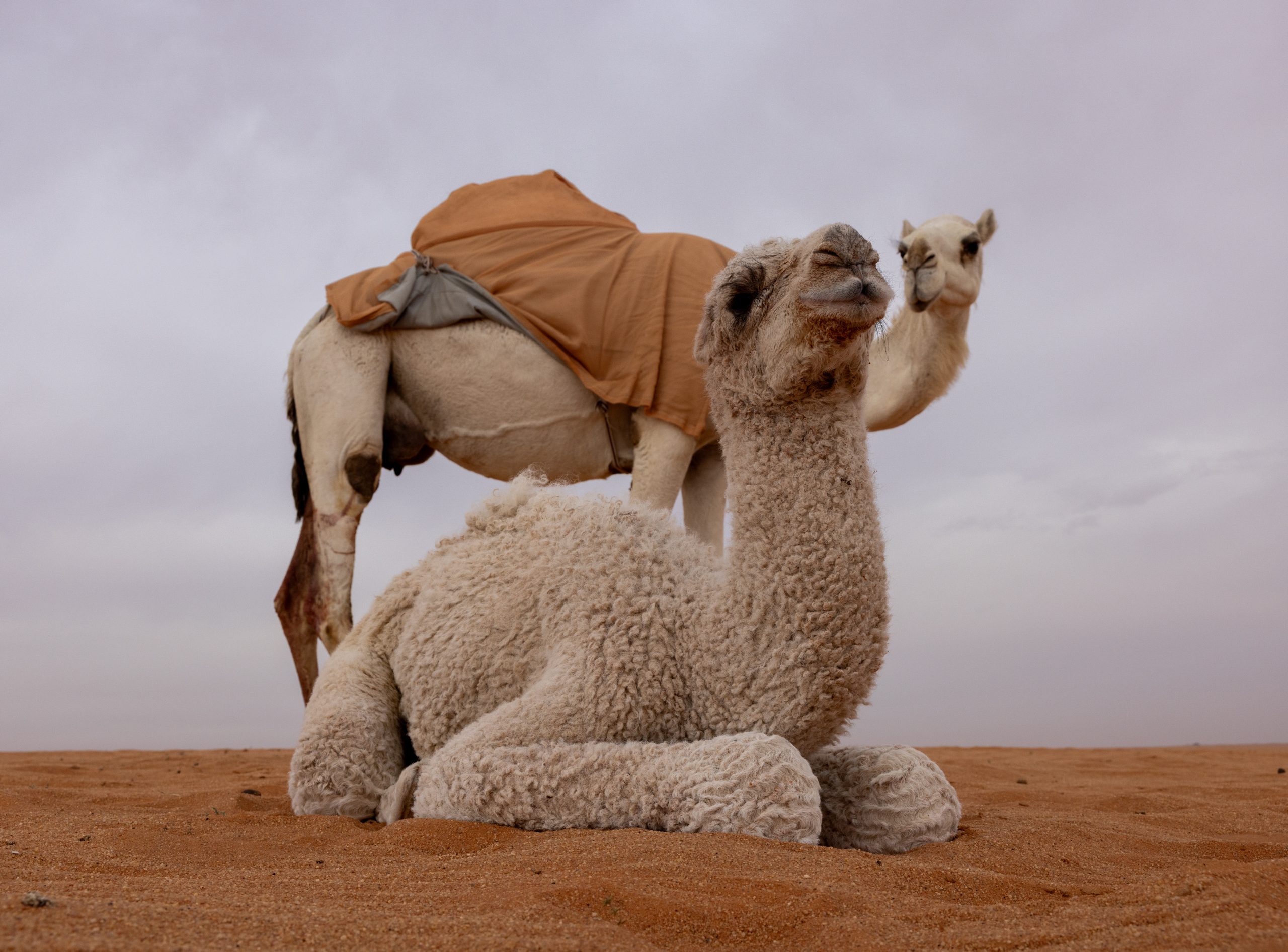
Photo by Saleh Al Hathloul
Inside one of the desert’s most remarkable survival systems
Under the sun, water can become more than a necessity. It becomes a biological challenge.
A camel may travel through extreme heat while losing a remarkable amount of its body water. With every hour of dehydration, there is less fluid circulating through its body. Its blood becomes more concentrated. Salts accumulate. Cells are exposed to conditions that would place most mammals under severe physiological stress.
Yet the camel keeps moving.
There is a remarkable story happening somewhere we cannot see: inside its blood.
When water begins to disappear
Imagine a dromedary camel (Camelus dromedarius) travelling through an arid landscape.
Hours become days without drinking.
As water leaves its body through respiration, urine, feces and evaporation, the amount of fluid circulating in its bloodstream begins to fall. The blood plasma, the liquid portion of blood, becomes more concentrated.
In one controlled study of camels undergoing prolonged dehydration, plasma volume fell by approximately 42%, while plasma sodium concentration rose from around 154 to 191 mmol/L.[1]
For most mammals, such dramatic changes in body water would place enormous stress on circulation and cells.
The camel has evolved differently.
Classic physiological studies found that camels can tolerate water losses approaching 30% of their body weight under severe desert conditions.[2]
That tolerance depends on several systems working together, from the kidneys and hormonal regulation to the unusual properties of the camel’s blood.
And at the centre of the story is a remarkable cell.
The unusual red blood cell
Look at human red blood cells under a microscope and they appear as round, flexible discs.
Camel red blood cells look different. They are small, flattened and elliptical, almost oval-shaped.[3]
This unusual architecture is particularly suited to an animal whose blood chemistry can change substantially between dehydration and rehydration.
As dehydration progresses and plasma becomes increasingly concentrated, water tends to move out of cells through osmosis.
Camel erythrocytes are unusually resistant to these osmotic stresses. Research has shown that the characteristics of camel red cells change with hydration state and that cells from dehydrated camels become particularly resistant to rupture when exposed experimentally to hypotonic conditions.[4]
Their internal chemistry is unusual as well. Camel erythrocytes have exceptionally low cellular water content, while camel haemoglobin contains a relatively high proportion of charged, hydrophilic amino-acid residues. Researchers have proposed that these characteristics form part of the camelid adaptation to repeated osmotic stress in arid environments.[5]
In simple terms: the camel’s red blood cells are built to keep functioning while the water balance around them changes dramatically.
Meanwhile, the blood is sending an emergency signal
The bloodstream is not simply enduring dehydration. It is also helping coordinate the body’s response.
As plasma volume falls and its concentration increases, hormonal systems responsible for conserving water become activated.
One important hormone is arginine vasopressin, also known as antidiuretic hormone.
During a 14-day dehydration experiment, researchers recorded a substantial increase in circulating vasopressin as dehydration progressed. Plasma renin activity, part of another major system regulating blood pressure, sodium and fluid balance, also increased markedly.[1]
These signals tell the body that water has become precious. The kidneys respond accordingly.
Urine production can fall dramatically while urine becomes increasingly concentrated. In the same study, average urine production declined from approximately 4.6 litres per day to 0.8 litres per day, while urine osmolality roughly doubled.[1]
Every drop begins to matter. The camel is no longer behaving physiologically as though water were readily available.
Its entire internal system has shifted toward conservation.
When water returns
Eventually, the camel reaches water. And now it faces a completely different physiological challenge.
A severely dehydrated camel can drink an enormous quantity in a remarkably short period. Classic observations showed camels replacing very large water deficits within minutes.[2]
Suddenly, an animal whose body fluids had become highly concentrated receives a massive influx of fresh water.
For ordinary cells, such a rapid change in the surrounding fluid environment can be dangerous.
Water moving rapidly into red blood cells causes them to swell. If swelling becomes excessive, the membrane can rupture, a process known as haemolysis.
Camel red blood cells are remarkably resistant to osmotic haemolysis.[3][4]
But there is another layer to the story.
The water a camel drinks does not simply pour instantly into its bloodstream.
Research following dehydrated camels after a large drink found that plasma protein concentrations did not change abruptly. This suggests that physiological mechanisms—including the gastrointestinal system—help regulate how rapidly water reaches the circulation, limiting sudden changes in plasma osmolarity.[6]
The camel therefore survives not because its cells are indestructible, but because multiple adaptations work together.
The digestive system controls water movement. The circulation tolerates substantial changes in volume and concentration. The red blood cells withstand unusual osmotic conditions. The kidneys conserve water. And hormonal systems continuously adjust the balance.
A desert adaptation written into the blood
For Saudi Arabia, the camel is far more than an animal adapted to heat.
It has travelled alongside the people of the Arabian Peninsula for generations, supporting transportation, food systems, trade and life across some of the world’s most water-limited landscapes.
Modern physiology allows us to see another dimension of that relationship.
The camel’s legendary endurance is not produced by one extraordinary organ or a hidden reservoir of water.
It is the result of a coordinated biological system.
As dehydration deepens, its blood becomes more concentrated and plasma volume decreases. Hormonal signals intensify. The kidneys conserve increasingly valuable water. And throughout these changes, unusually resilient red blood cells continue circulating through the body.
Then, when water finally arrives, the entire process shifts rapidly toward recovery.
What appears from the outside as a camel simply walking across the desert is, on the inside, an extraordinary exercise in physiological balance.
The desert did not teach the camel how to store water. Evolution equipped it to survive when water disappears.
Scientific Sources
1. Yagil, R., Sod-Moriah, U.A. & Meyerstein, N. “Hormonal control of water and sodium in plasma and urine of camels during dehydration and rehydration.” Journal of Physiology, 1993.
Findings include changes in plasma volume, sodium concentration, vasopressin, renin activity, urine volume and urine osmolality during 14 days of dehydration and subsequent rehydration.
PubMed PMID: 8335227.
2. Schmidt-Nielsen, K., Schmidt-Nielsen, B., Jarnum, S.A. & Houpt, T.R. “Water Balance of the Camel.” American Journal of Physiology, 1956; 185(1):185–194.
A foundational experimental investigation of water deprivation and rehydration in camels under desert conditions.
3. “From Desert to Medicine: A Review of Camel Genomics and Therapeutic Products.” Frontiers in Genetics, 2019; 10:17.
Reviews camel physiological adaptations, including the morphology and osmotic resistance of camel erythrocytes.
4. Yagil, R., Sod-Moriah, U.A. & Meyerstein, N. “Dehydration and camel blood. III. Osmotic fragility, specific gravity, and osmolality.” American Journal of Physiology, 1974; 226(2):305–308.
Experimental research examining changes in camel erythrocytes during dehydration and rehydration.
5. Bogner, P., Csutora, P., Cameron, I.L., Wheatley, D.N. & Miseta, A. “Augmented water binding and low cellular water content in erythrocytes of camel and camelids.” Biophysical Journal, 1998.
Investigates camel erythrocyte water content and haemoglobin characteristics in relation to osmotic adaptation.
6. “Influence of dehydration and watering on camel red cell size: a scanning electron microscopic study.” Journal of Zoology, 1990.
Examined erythrocyte morphology and plasma changes during dehydration and rapid watering.
Additional reference: “Physiological and behavioral responses to different watering intervals in lactating camels (Camelus dromedarius).” American Journal of Physiology – Regulatory, Integrative and Comparative Physiology, 2013. Research examining plasma volume, osmolality, sodium, vasopressin and rehydration during different periods of water deprivation.