The Secret Inside the Camel: How Nature Learned to Save Every Drop
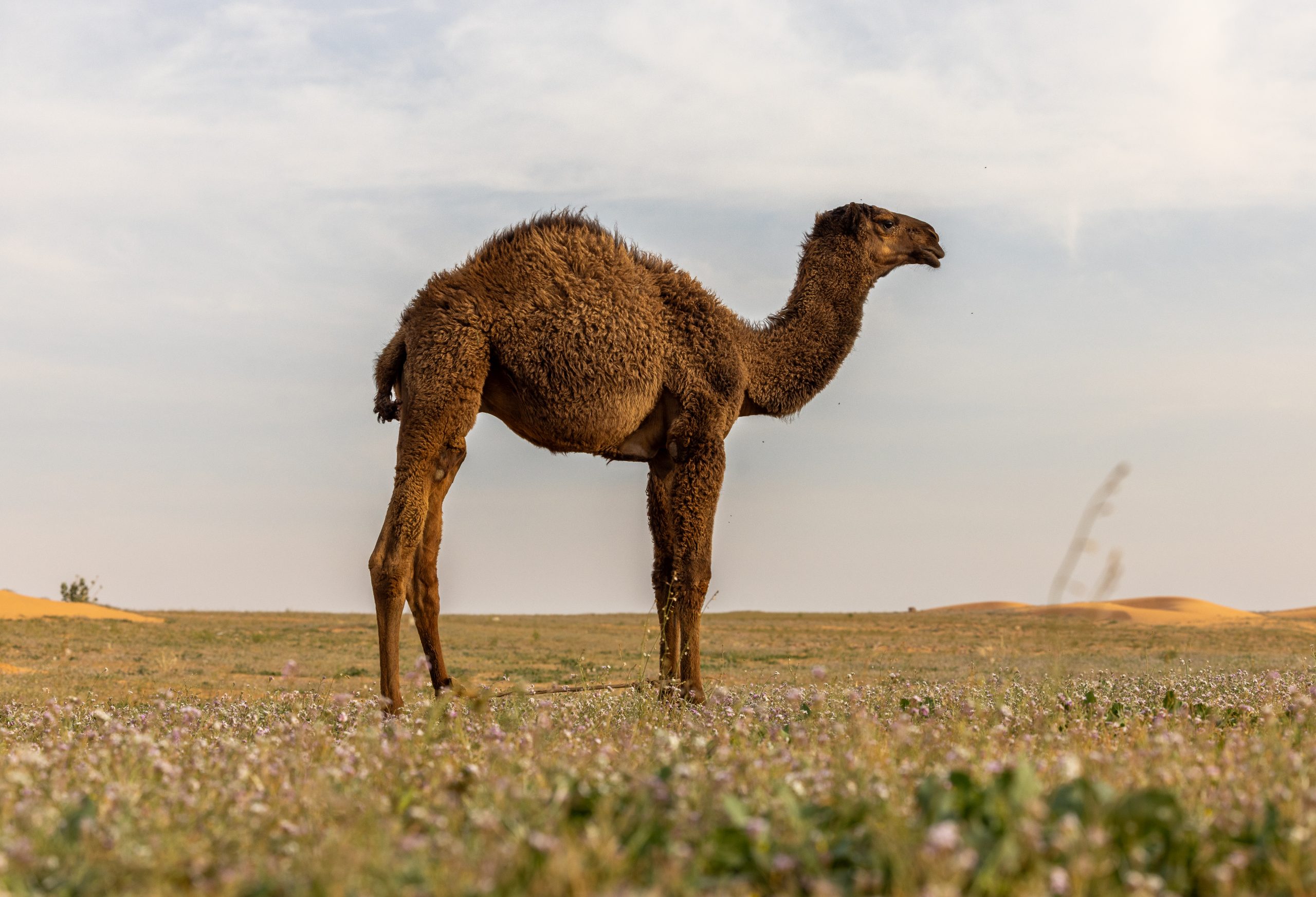
Photo by Saleh Al Hathloul
For centuries, the camel has carried people across Arabia’s most demanding landscapes. Today, science is revealing just how extraordinary its relationship with the desert truly is.
Long before roads crossed the Arabian Peninsula, the camel already knew the way.
It travelled between settlements, carried people and goods across vast distances, provided milk and nourishment, and became inseparable from the rhythms of life in the desert.
In Saudi Arabia, the camel is more than an animal shaped by its environment. It occupies a distinctive place in the Kingdom’s cultural memory and living heritage, a symbol of endurance, companionship and adaptation to the land.
But beneath this familiar story lies another, largely invisible one.
Inside the camel is a biological system refined for one of Arabia’s greatest challenges: water scarcity.
And at the centre of that system is an extraordinary organ; the kidney.
The Desert Leaves Its Signature
The Arabian desert asks difficult questions of every organism that lives within it.
How do you endure intense heat when water is scarce? How do you travel long distances without reliable access to it? And when water finally appears, how does the body recover?
The dromedary camel (Camelus dromedarius) has evolved remarkable answers.
Classic physiological research demonstrated that camels can tolerate water losses approaching 30 percent of their body weight under severe desert conditions.[1]
For most mammals, dehydration on such a scale would represent a profound physiological crisis.
The camel survives not because its famous hump is filled with water, it primarily stores fat, but because its entire physiology has evolved around careful management of water.
Few organs illustrate that strategy as elegantly as the kidney.
Inside the Camel’s Water Economy
A kidney has a difficult job even under ordinary circumstances.
Every day, it must filter the blood, remove metabolic waste, regulate electrolytes and decide how much water the body can afford to lose.
For an animal living in the Arabian desert, that final decision becomes critical.
During water deprivation, the camel dramatically reduces its urine production. Classic experimental research recorded urine volumes falling to approximately 0.5–1 litre per day under certain conditions.[1]
But the body cannot simply stop producing urine. Metabolic waste must still be removed.
The solution is concentration.
The camel kidney reclaims water while allowing waste products to leave in a much smaller volume of fluid.
It is an elegant biological principle:
eliminate what must be lost, preserve what cannot be easily replaced.
A Hidden Architecture Built for Conservation
Look inside the camel kidney and the strategy becomes even more remarkable.
Deep within it lies the renal medulla, the region that plays a central role in producing concentrated urine.
Here, microscopic structures called loops of Henle work alongside collecting ducts and blood vessels to establish osmotic gradients. These gradients allow water to move out of the forming urine and back toward the body.
Anatomical research has revealed distinctive features in the dromedary kidney, including a substantial medulla and an elaborate renal pelvis with numerous recesses extending alongside the medullary tissue.[2]
The renal papillae are fused into a structure known as the renal crest, creating an extensive interface between the renal pelvis and medulla.
Within this system, even something we normally think of simply as waste becomes useful.
Urea.
Urea contributes to the highly concentrated environment of the renal medulla. Researchers have proposed that the anatomy of the camel kidney facilitates the recycling of water and urea from pelvic urine, supporting the osmotic conditions needed to conserve water.[2]
In an environment where every drop matters, biology finds value even in what the body is preparing to discard.
The Desert Response Goes Down to the Molecule
The story becomes even more intriguing at the microscopic level.
Within kidney-cell membranes are specialized proteins known as aquaporins.
Think of them as microscopic gateways for water.
When dehydration begins, the camel kidney does not simply continue operating normally while producing less urine. Its molecular machinery responds.
Research into the Arabian camel kidney has identified dehydration-associated changes involving several aquaporins, including AQP1, AQP2 and AQP3.[3]
AQP2 is particularly important because of its role in regulating water reabsorption in the kidney. During dehydration, researchers observed increased expression of this water channel.[3]
More recent research has identified changes involving additional aquaporins and solute-transport systems during dehydration and subsequent rehydration.[4]
The implication is fascinating.
The camel kidney is not simply anatomically suited to the desert.
It responds to the desert in real time.
An Unexpected Discovery: Cholesterol
Then scientists discovered another piece of the puzzle.
One that, at first, seems far removed from desert survival.
Cholesterol. A multiomic study of the Arabian camel kidney found that dehydration suppressed genes involved in cholesterol production.[3]
Why might that help conserve water?
Cholesterol influences the physical properties of cell membranes and can affect the behaviour of proteins within them.
Researchers proposed that reducing membrane cholesterol could facilitate the activity of AQP2, potentially supporting greater movement of water through kidney cells during dehydration.[3]
It is an extraordinary example of how adaptation can operate at multiple scales.
From the shape of an organ to the behaviour of individual molecules, different biological systems appear to converge on the same objective: protect water.
Water Is Only Part of the Equation
Yet conserving water alone is not enough.
The kidney must also regulate sodium and other electrolytes.
This is crucial because water and salts are physiologically intertwined. Alter one and the other is affected.
Genomic research has identified adaptations in camels involving genes associated with renal function and sodium transport.[5] During dehydration, mechanisms controlling water and ions adjust together.
This allows the camel to conserve fluid while continuing to maintain the internal chemical environment required for nerves, muscles and cells to function.
Desert survival, then, is not simply an exercise in endurance.
It is an exercise in precision.
Adapted Does Not Mean Invulnerable
The camel’s abilities can sound almost impossible.
But science reveals an important distinction.
The camel is exceptionally adapted to dehydration. It is not immune to its effects.
Studies examining kidney tissue after prolonged dehydration have identified cellular and structural changes, including alterations affecting renal tubular cells and components of the kidney’s filtration system.[4]
Research has also detected changes in markers associated with oxidative stress and inflammation.[6]
Following rehydration, many of these changes improve.
This makes the camel’s physiology perhaps even more remarkable.
Its strength is not that environmental stress leaves no mark.
Its strength lies in its capacity to withstand, respond and recover.
When Water Finally Appears
Then the desert changes. A water source appears.
And an animal that has spent days conserving every possible drop can suddenly drink an enormous quantity in a remarkably short period.[1]
Now the challenge facing the body is reversed.
The kidney must transition from defending against scarcity to managing renewed abundance.
Research shows that molecular systems altered during dehydration, including aquaporins and ion-transport mechanisms, change again following rehydration.[3,4]
The kidney adjusts. The water balance begins to recover. The conservation system shifts.
That flexibility may be as important as the ability to endure dehydration itself.
The camel is adapted not simply to scarcity, but to the dramatic transitions between scarcity and abundance that characterize desert life.
An Arabian Story Written in Biology
For generations across the Arabian Peninsula, people understood the camel through experience.
They knew its endurance. They knew how far it could travel. They understood its ability to withstand conditions that tested both people and animals.
Modern science allows us to see another dimension of that familiar story.
Beneath the camel’s endurance lies an extraordinary coordination of anatomy, physiology and molecular biology.
Its renal architecture helps create the conditions for intense water conservation.
Its kidney can produce highly concentrated urine.
Urea can contribute to the mechanisms that help reclaim water.
Aquaporins respond as dehydration progresses. Ion-transport systems adjust. Even cellular cholesterol metabolism appears to participate in the response.
And when water returns, the system changes again.
The camel’s relationship with the Arabian desert is therefore written not only in history, poetry and cultural memory.
It is written in its biology.
A Masterclass in Conservation
Perhaps this is what makes the camel so scientifically compelling.
It is easy to look at an animal that has accompanied life in Arabia for centuries and believe we already know it.
Science suggests otherwise.
Inside the camel are adaptations still being investigated, mechanisms that may deepen our understanding of how mammalian bodies respond to dehydration, osmotic stress and extreme environments.
The camel did not conquer the desert by carrying an endless supply of water.
It evolved something far more sophisticated:
the ability to protect what it has.
To lose less. To recover more. To adapt when conditions change.
For centuries, the camel has been a symbol of endurance in Arabia.
Modern biology is beginning to reveal the extraordinary machinery behind that endurance.
And inside the kidney, one of the desert’s oldest stories is being read in an entirely new way.
Scientific References
- Schmidt-Nielsen B, Schmidt-Nielsen K, Houpt TR, Jarnum SA. Water Balance of the Camel. American Journal of Physiology. 1956;185(1):185–194. doi:10.1152/ajplegacy.1956.185.1.185.
- Abdalla MA, Abdalla O. Anatomical features in the kidney involved in water conservation through urine concentration in dromedaries (Camelus dromedarius). Heliyon. 2020;6(1). doi:10.1016/j.heliyon.2019.e03139.
- Alvira-Iraizoz F, Gillard BT, et al. Multiomic analysis of the Arabian camel (Camelus dromedarius) kidney reveals a role for cholesterol in water conservation. Communications Biology. 2021;4:779. doi:10.1038/s42003-021-02294-7.
- Abu Damir H, Ali MA, Adem MA, et al. Effects of long-term dehydration and quick rehydration on the camel kidney: pathological changes and modulation of the expression of solute carrier proteins and aquaporins. BMC Veterinary Research. 2024;20:367. doi:10.1186/s12917-024-04215-4.
- Wu H, Guang X, Al-Fageeh MB, et al. Camelid genomes reveal evolution and adaptation to desert environments. Nature Communications. 2014;5:5188. doi:10.1038/ncomms6188.
- Ali MA, Adem A, Chandranath SI, et al. The effect of long-term dehydration and subsequent rehydration on markers of inflammation, oxidative stress and apoptosis in the camel kidney. BMC Veterinary Research. 2020.