The Parasite That Wrote History
History was never merely shaped by armies or empires. Beneath it, there have always been smaller, invisible forces, far more decisive and far more lethal than any weapon. They were never mapped by generals or accounted for in war budgets, yet they were always present, working silently, reshaping the world with slow and relentless precision.
One of these forces is the malaria parasite, a microscopic organism that did not simply infect humans but also redistributed them, redefining geography itself, as if writing a parallel history that only becomes visible after it has already unfolded.
Today, malaria infects more than 240 million people each year and claims nearly 600,000 lives, most of them children in sub-Saharan Africa. Yet even these numbers are only a narrow statistical shadow of a much deeper reality. Malaria has never been merely a disease, but a hidden force redefining the boundaries of what is possible.
When Empires Fail
There are moments in history that were not decided by swords, but by fever. Entire armies entered territories without realizing they had stepped into a different kind of war. Soldiers faced an enemy they could not see, negotiate with, or defeat through any conventional means.
In Africa, it was not geography alone that resisted expansion, but a parasite that turned landscapes into biological fortresses and the air itself into a silent threat. In many places, borders were not drawn on land, but within blood. The parasite understood what leaders did not—that control over geography begins with control over the human body.
When Science Realizes It Is Late
When humanity entered the laboratory, it did not enter as a victor, but as a latecomer. It began to understand that it was confronting not a simple organism, but a dynamic biological system that evolves, adapts, and reinvents itself with every attempt to control it.
This marked the beginning of one of the longest battles in modern science, led by institutions such as the World Health Organization and supported by global initiatives and figures like Bill Gates, all attempting to decode an ancient enemy.
Yet beneath this progress lingered a quiet realization: the answer might not come from repeating the same questions, but from redefining them entirely.
The Scientist Who Questioned Modernity
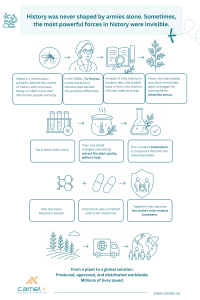
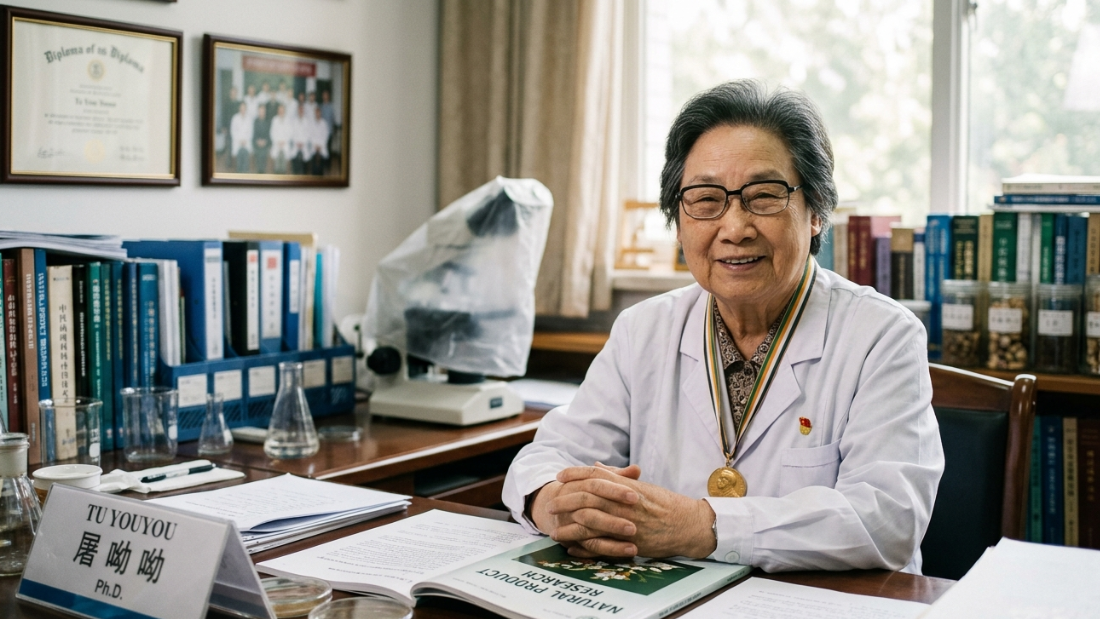
In the 1960s, Tu Youyou began a different kind of journey. She did not begin with certainty, but with doubt.
She turned to a vast body of traditional knowledge not as a relic, but as a possibility. Among ancient texts, she found references to a plant used to treat fever. Modern extraction methods failed because they imposed assumptions that ignored the nature of the material.
The breakthrough came when she changed not the experiment, but the question itself.
Returning to the original texts, she noticed a critical detail: extraction should occur at low temperatures. That subtle observation changed everything.
The result was artemisinin, a life-saving therapy that earned her the Nobel Prize in Physiology or Medicine. Yet her real contribution was not merely a drug, but a new way of thinking, one in which tradition and science are not opposites, but deeply connected pathways to discovery.
A Disease of the Developing World or a Mirror of the World?
Despite all progress, malaria is still labeled a disease of the developing world. Yet this label reveals more about the global system than the disease itself.
It exposes the gap between what science can achieve and what actually reaches people.
The challenge is no longer discovery alone, but delivery, equity, and the systems that determine who receives solutions and who must wait.
Malaria is no longer just a biological problem, but a test of global integrity.
When Research and Development Become the Spearhead
At this point, the definition of the battle changes entirely.
The question is no longer whether we can discover treatments, but whether we can build sustained systems of research and development that make discovery continuous rather than occasional.
Here, science-based research and development become the spearhead of humanity’s path toward a better future—not only because they produce medicines, but because they reshape our ability to understand, anticipate, and respond before it is too late.
What We Truly Learned
The greatest breakthroughs do not come from speed, but from the courage to question, rethink, and challenge dominant assumptions.
Knowledge is not linear, but an evolving interaction between past and present between laboratory and legacy.
And science, when grounded in deep vision, becomes a force that restores balance to the world, rather than merely treating its symptoms.
Beyond Malaria
This is not a story about a disease.
It is a story about how humanity thinks when confronted with the unknown—and how a single idea can alter the fate of millions.
Somewhere right now, in a laboratory or within an overlooked text, there is an idea waiting to be seen.
Because true breakthroughs are not only invented, they are discovered when we are ready to see them and when we are ready to build them through rigorous science and relentless research and development.
Key Scientiffic & Historical Sources
- World Health Organization – Malaria Fact Sheet
- WHO World Malaria Report 2024
- World Health Organization – Global Malaria Programme
- The Nobel Prize – Tu Youyou Facts
- Nature Communications malaria resistance study